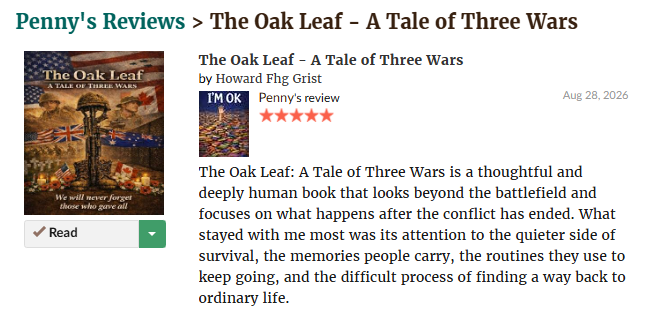
The Oak Leaf: A Tale of Three Wars
Is a thoughtful and deeply human book that looks beyond the battlefield and focuses on what happens after the conflict has ended. What stayed with me most was its attention to the quieter side of survival, the memories people carry, the routines they use to keep going, and the difficult process of finding a way back to ordinary life.
I appreciated that the story does not appear to treat war simply as a source of action or drama. Instead, it focuses on the people shaped by those experiences and the contradictions that can exist within them. There are moments of resilience, humor, pain, and reflection, which made the characters and themes feel grounded and relatable.
The idea that survival is an ongoing practice rather than a single victorious moment is one of the book's strongest messages. Healing is also presented as something gradual, sometimes found in small and familiar moments rather than dramatic transformations.
This is not just a story for readers with a military connection. It also offers something meaningful for anyone interested in how people carry difficult experiences and continue moving forward.
Overall, The Oak Leaf is a reflective and compassionate read that emphasizes the quiet strength of the human spirit and the long, complicated journey toward healing and peace.
🌍 Historical & Human Context
Although the book spans three major conflicts, it avoids becoming a geopolitical treatise. Instead, it focuses on:
the human cost of duty,
the long shadows cast by war,
and the private reckonings that follow service.
For readers who have served, or loved someone who has, the book offers recognition without burden and honesty without despair. For those unfamiliar with military life, it opens a door to the emotional realities behind the uniforms.
📚 Strengths
Deep psychological insight — rare in war literature.
Elegant, reflective prose that prioritizes emotional truth.
A unique origin story that ties childhood trauma to adult identity.
Authentic portrayal of intelligence and military environments.
Universal themes of survival, identity, and healing.
⚠️ Potential Limitations
Readers seeking fast-paced military action may find it too introspective.
The nonlinear emotional structure requires patience and reflection.
The book’s quiet tone may feel heavy for those expecting traditional war narratives.
🏁 Final Verdict
The Oak Leaf – A Tale of Three Wars is a powerful, introspective, and emotionally resonant novel that reframes war as a lifelong internal journey. It’s less about battles and more about the human spirit — its fractures, its endurance, and its quiet attempts to heal. For readers who appreciate literary war non fiction with psychological depth, this is a standout work.
Book Review: The Oak Leaf - A Tale of Three Wars by Fred Howard Grist
The Oak Leaf - A Tale of Three Wars, written by Fred Howard Grist (published by Frederick Howard Grist), steps away from the traditional, macro-level battlefield strategies and chronological battle histories that dominate military literature. Instead, this reflective work zeroes in on a deeply human canvas: the long, winding arc of a life shaped by conflict.
Core Themes and Narrative Focus
Rather than focusing purely on the adrenaline and tactical execution of combat, Grist’s narrative is captivated by the thresholds, the silences, and the aftermath. The book explores how warfare operates not just as a series of historical events, but as an internal landscape. As the text suggests, while war leaves endless marks, many of the most profound ones are invisible—settling quietly into the human body and memory long after the guns have fallen silent.
The framing of "three wars" acts as both a historical anchor and a psychological lens, tracking how trauma, resilience, and survival evolve across different eras of conflict.
Strengths
• Introspective Depth: Grist excels at capturing the quiet moments that follow chaos, giving readers an evocative look into post-conflict psychology.
• Lyrical Observation: The writing often treats memory and instinct as overlapping terrains, offering a poetic gravity to otherwise heavy subject matter.
• A Fresh Perspective: By bypassing purely clinical military history, it offers a poignant companion piece for readers interested in the human side of defense and warfare history.
Who Is It For?
This book is best suited for readers who appreciate military history told through a personal lens, psychological explorations of veterans, and reflective literature akin to modern memoirs and character-driven historical narratives. It is less about sweeping tactical movements and more about the enduring footprints left on a single life.
Are you looking into this book for its historical context on a specific conflict, or are you drawn more toward character-driven military memoirs and fiction?